Stainless Steel Grades Explained: Choosing the Right Grade for Industrial Pipe Fittings and Flanges
The Stainless Steel Paradox
Stainless steel is one of the most misunderstood materials in industrial procurement. The term "stainless" suggests a universal, corrosion-proof material — but in reality, the family of stainless steels contains hundreds of distinct alloys with dramatically different corrosion resistance, mechanical properties, temperature capabilities, and costs. Specifying "stainless steel" without a grade designation is as imprecise as specifying "medicine" without naming the drug.
The consequences of incorrect grade selection range from costly to catastrophic. Using Grade 304 in a chloride-rich marine environment invites stress corrosion cracking. Using 316L in a hot concentrated nitric acid environment leads to rapid corrosive attack. Specifying a standard austenitic grade for cryogenic service without verifying impact properties may create a brittle fracture risk.
At Remax Forge & Fittings, we manufacture pipe fittings and flanges in virtually every commercially significant stainless steel grade. This guide provides the technical foundation you need to select the right grade for your specific service conditions.
The Stainless Steel Family — A Metallurgical Overview
Stainless steels are iron-based alloys containing a minimum of 10.5% chromium by mass. The chromium reacts with oxygen in the atmosphere to form a thin, adherent, self-repairing chromium oxide (Cr₂O₃) passive layer on the surface — the source of corrosion resistance. When this passive layer is maintained intact, stainless steel resists corrosion. When it is disrupted by mechanical damage, aggressive chemicals, high temperatures, or improper heat treatment, corrosion can proceed rapidly.
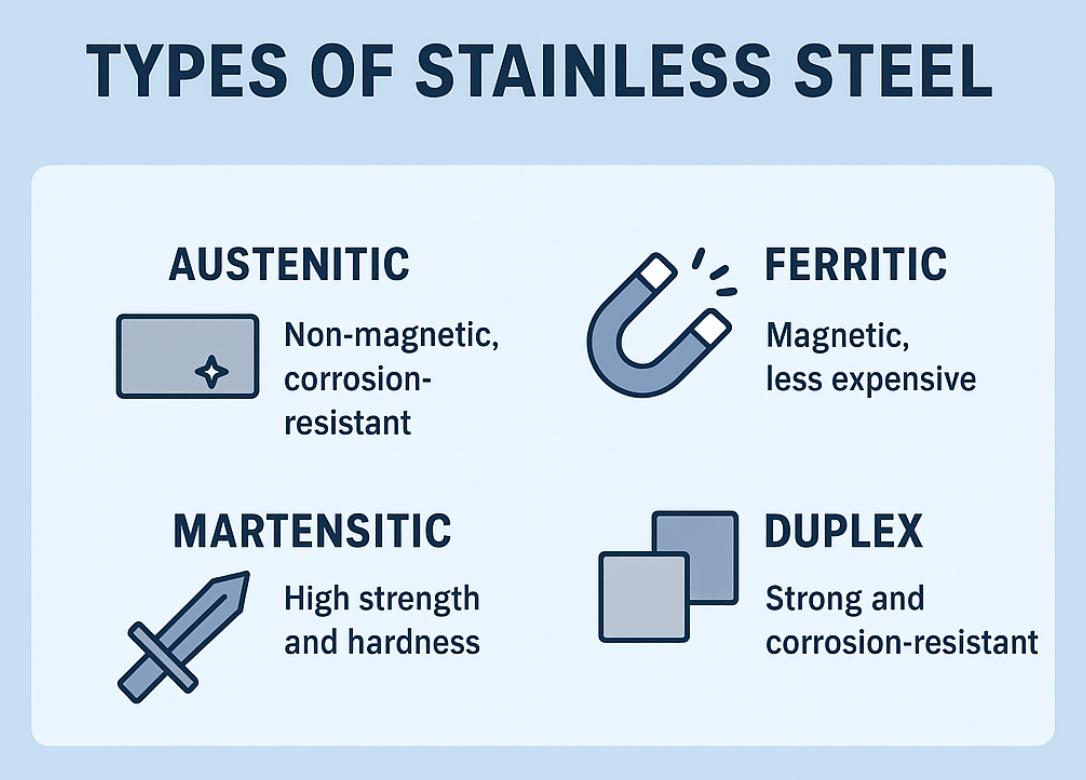
The stainless steel family is divided into five main classes, based on microstructure:
Austenitic Stainless Steels
The most widely used class, austenitic stainless steels contain sufficient chromium (16–26%) and nickel (6–22%) — sometimes with additions of manganese or nitrogen — to stabilize the austenite (face-centered cubic) crystal structure at room temperature. This gives them excellent corrosion resistance, good weldability, and non-magnetic properties in the annealed condition.
Key grades: 304, 304L, 316, 316L, 317L, 321, 347, 904L, 310S
Austenitic stainless steels cannot be hardened by heat treatment — only by cold working. They retain good toughness to cryogenic temperatures, making them suitable for LNG service.
Ferritic Stainless Steels
Ferritic grades contain chromium (10.5–30%) but minimal nickel, maintaining a body-centered cubic (ferritic) structure. They are magnetic, generally less expensive than austenitics, and offer good corrosion resistance but limited toughness — particularly in welded conditions.
Key grades: 409, 430, 444
Ferritic grades are rarely used for industrial pressure-containing fittings and flanges due to their limited toughness and weldability. They are more common in automotive exhaust and architectural applications.
Martensitic Stainless Steels
Martensitic grades are hardenable by heat treatment (quench and temper), offering high strength and hardness. They contain chromium (11–18%) with minimal nickel and are magnetic. Their corrosion resistance is lower than austenitic grades.
Key grades: 410, 420, 431, 440C, 17-4 PH (semi-martensitic/precipitation hardening)
Used primarily for shaft sleeves, pump impellers, valve stems, and fasteners where high strength and moderate corrosion resistance are needed.
Duplex Stainless Steels
Duplex grades contain approximately equal proportions of austenite and ferrite, giving them a two-phase microstructure. This unique structure provides the corrosion resistance of austenitic grades combined with yield strength approximately twice as high — allowing thinner walls to achieve equivalent pressure ratings.
Key grades: 2205 (UNS S31803/S32205), 2304 (UNS S32304)
Super duplex grades: 2507 (UNS S32750), Zeron 100 (UNS S32760)
Precipitation Hardening (PH) Stainless Steels
PH grades can be hardened to very high strength levels through a low-temperature aging treatment, with minimal distortion. They combine high strength, good corrosion resistance, and ease of machining.
Key grades: 17-4 PH (UNS S17400), 15-5 PH (UNS S15500)
The Austenitic Grades in Depth — 304 vs 316 and Beyond
Grade 304 (UNS S30400) — The General-Purpose Standard
Composition: 18% Cr, 8% Ni (the classic "18-8" stainless)
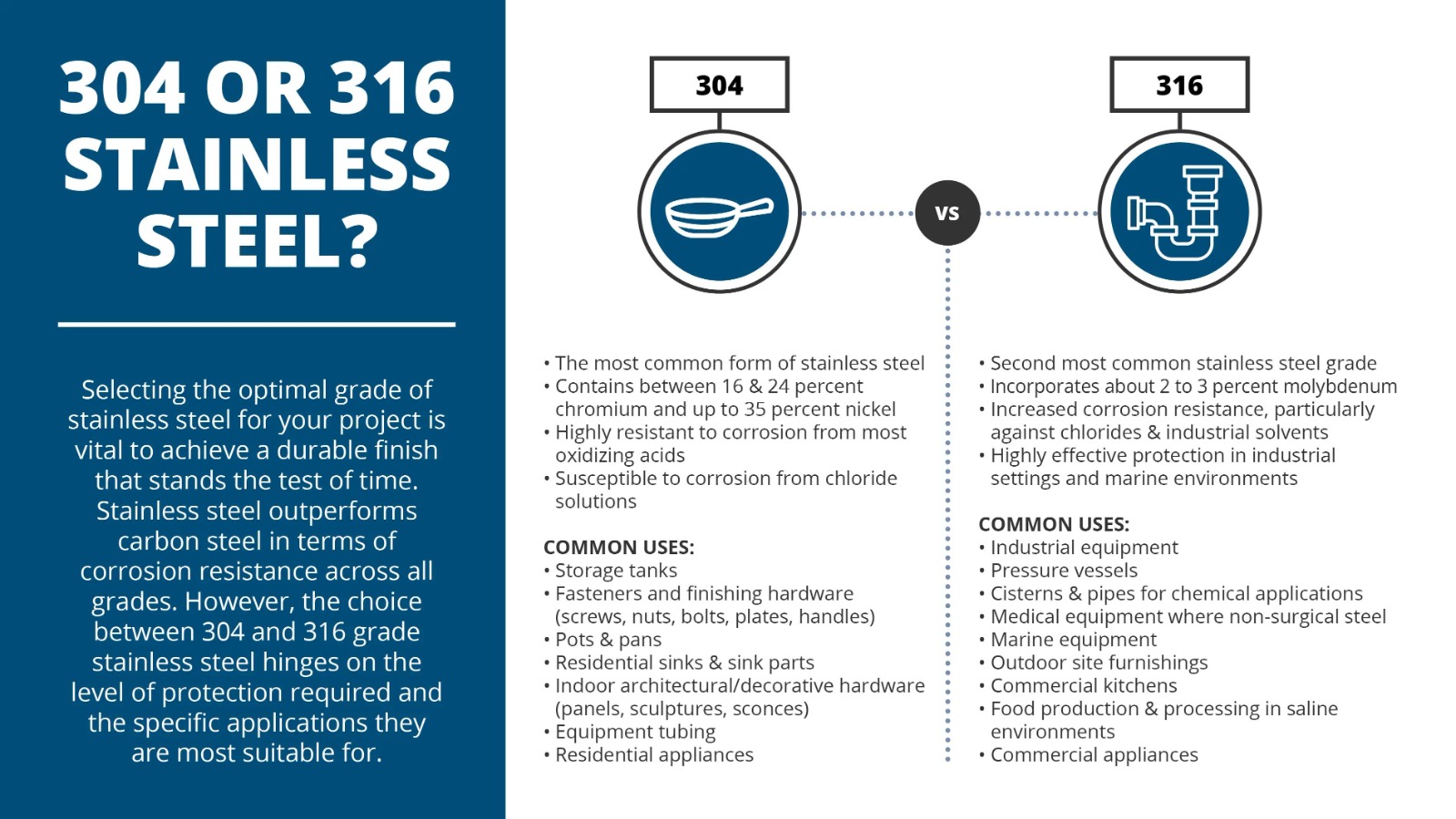
Grade 304 is the most widely produced stainless steel in the world. Its combination of corrosion resistance, formability, and cost makes it suitable for an enormous range of applications — food processing equipment, kitchen appliances, dairy industry, pharmaceutical vessels, and general chemical service.
For piping components, 304 is suitable for:
- Non-chloride chemical service
- Food, beverage, and pharmaceutical process lines
- Cryogenic service (down to -269°C)
- Atmospheric corrosion in mild to moderate environments
- Dilute acids in the low-to-moderate temperature range
The critical limitation of 304: chloride stress corrosion cracking (Cl-SCC). At temperatures above approximately 60°C in the presence of chloride ions and tensile stress, 304 is susceptible to transgranular cracking that can cause sudden brittle-appearing failure with no prior visible corrosion.
Grade 304L (UNS S30403) — Low Carbon for Welded Construction
In 304L, the extremely low carbon content (0.030% max) minimizes carbide precipitation, reducing sensitization risk during welding. For most welded applications in non-high-temperature service, 304L is preferred over 304.
Grade 316 (UNS S31600) — The Molybdenum Advantage
Composition: 16–18% Cr, 10–14% Ni, 2–3% Mo
The addition of 2–3% molybdenum significantly enhances corrosion resistance, particularly against chloride pitting, crevice corrosion, and reducing acids. It is the workhorse grade in chemical processing, offshore piping, and pharmaceutical manufacturing.
Grade 316L (UNS S31603) — The Standard for Welded Stainless Piping
The combination of molybdenum corrosion resistance and low carbon weldability makes 316L the most commonly specified stainless steel grade for industrial pipe fittings and flanges worldwide.
Specialty Austenitic Grades
- Grade 317L: Enhanced molybdenum (3–4%) for severe chloride service.
- Grade 321 & 347: Stabilized with titanium or niobium for high-temperature service (800–1,500°F) to prevent sensitization.
- Grade 904L: Ultra-high corrosion resistance (4–5% Mo, 1–2% Cu) for sulfuric acid and aggressive sour environments.
Duplex Grades — When Strength and Corrosion Resistance Both Matter
Grade 2205 — The Duplex Workhorse
Composition: 22% Cr, 5% Ni, 3% Mo, 0.17% N
Key properties vs. 316L austenitic:
- Yield strength approximately 2× higher
- Superior resistance to chloride pitting and crevice corrosion (PREN ~35 vs ~25)
- Highly resistant to chloride stress corrosion cracking
- Good resistance to erosion-corrosion
Super Duplex 2507 — Maximum Performance
Super duplex 2507 represents the pinnacle of the duplex family, with a PREN exceeding 40 — substantially above the threshold for chloride environments like seawater.
Important Fabrication Considerations
Duplex stainless steels require careful welding procedures to maintain the balanced microstructure. Incorrect heat input can produce excess ferrite or trigger sigma phase — a brittle intermetallic that dramatically reduces toughness and corrosion resistance.
Corrosion Resistance — Key Failure Modes
Resistance to pitting is characterized by the Pitting Resistance Equivalent Number (PREN):PREN = %Cr + 3.3 × %Mo + 16 × %N
- Pitting & Crevice Corrosion: Localized attack initiated by breakdown of the passive layer, usually by chlorides.
- Chloride Stress Corrosion Cracking (Cl-SCC): The most dangerous failure mode for austenitic stainless. Switch to duplex grades for immunity.
- Intergranular Corrosion: Addressed by using 'L' grades or stabilized grades (321, 347).
Temperature Capabilities
Cryogenic Service (Below -100°C)
Austenitic stainless steels maintain excellent toughness to liquid nitrogen temperatures (-196°C) and below. They are the standard for LNG and liquid gas service.
Elevated Temperature Service (400°C and Above)
At temperatures above ~600°C, 316L experiences significant oxidation. Grade 310S offers superior oxidation resistance to ~1150°C. Note that duplex steels are unsuitable above 280°C due to embrittlement.
Conclusion: Get the Grade Right the First Time
Stainless steel grade selection is a genuine engineering decision with significant performance and cost implications. Specifying the right grade from the outset prevents premature failures, unnecessary upgrades, and unplanned maintenance.
Remax Forge & Fittings' technical team is available to assist with material selection questions, provide corrosion resistance guidance, and review material certificates for compliance with your project specifications.
Contact Remax Forge & FittingsFill this form and get a quote in 30 minutes — guaranteed
Let our experts take over from here!